I'm chuffed to again be able to share a guest post from my good friend Johnny, who writes very well. He's offered up a couple of posts here before, the most recent being the superb "The Death of Relativism", but doesn't have his own blog. He does, however, Tweet fairly well and often, so its yet another incentive to join that service. This post is about one of our shared 'heroes of the faith', German Pastor Dietrich Bonhoeffer, and his interesting perspective on 'truth'.
________________________________________
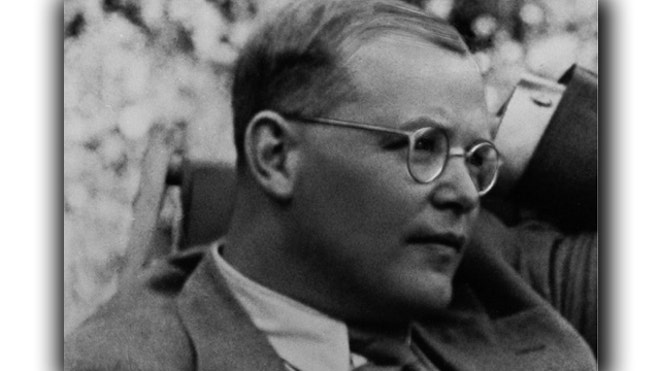
Truth-telling, Hitler, and the triple-agent pastor
Recently, I’ve been reading Eric Metaxas’s excellent biography of the great German wartime pastor Dietrich Bonhoeffer. I’ve just reached the rather confusing if gripping place where, in 1941, Bonhoeffer heads off to Eastern Germany to work as a theologian and pastor, teaching at a theological college and continuing his own writing - but using this as a cover to apparently work as an agent for the German Secret Service - but using this as a cover to be an important part of a conspiracy to overthrow - probably assassinate - Hitler and end the war. Unsurprisingly, Metaxas is aware that this may slightly trouble his readers! So he prefaces it with an extended reference to Bonhoeffer’s own essay ‘What is meant by ‘telling the truth’?’.
I dug up a copy, myself, and it makes fascinating and challenging reading. Bonhoeffer’s understanding of truth-telling is far more nuanced, challenging, and mature than a simple ‘tell the truth’ maxim. He challenges such a simple maxim of ‘always tell the truth’ as both going too far and not far enough. In fact, as he puts it,
“It is only the cynic who claims ‘to speak the truth’ at all times and in all places to all men in the same way, but who, in fact, displays nothing but a lifeless image of the truth. He dons the halo of the fanatical devotee of truth who can make no allowances for human weaknesses...He wounds shame, desecrates mystery, breaks confidence, betrays the community in which he lives, and laughs arrogantly at the devastation he has wrought and at the human weakness which ‘cannot bear the truth’. He says truth is destructive and demands its victims, and he feels like a god above these feeble creatures and does not know that he is serving Satan.”
Wow. OK then. But how does Bonhoeffer unpack this rather fire-and-brimstone rhetoric? There are two main criticisms Bonhoeffer has. First, saying simply ‘always tell the truth’ betrays the times when it is inappropriate to reveal the truth; second, he says that simply ‘not lying’ still allows for the insincerity that is utterly misleading and destructive, without technically ‘lying’.
First, then - Bonhoeffer says that it isn’t always appropriate to reveal all the truth. For example, he says, “a teacher asks a child in front of the class whether it is true that his father often comes home drunk...What goes on in the family is not for the ears of the class in school. The family has its own secret and must preserve it.” [Think of Bonhoeffer’s context, and the Hitler Youth!] Bonhoeffer concludes: the child should not lie, but the teacher has no right to ask for the truth, and the child no responsibility to give it. So, we shouldn’t lie, but that doesn’t mean we always need to reveal the truth.
However, second, we need to go further than ‘not saying stuff we know to be wrong.’ “There is a way of speaking which is in this respect entirely correct and unexceptionable, but which is, nevertheless, a lie. This is exemplified when a notorious liar for once tells ‘the truth’ in order to mislead.” I remember a mate of mine at school turning up to a class really late one day, and explaining “Sorry I’m late. The doctor’s was really busy this morning”, and then sitting down. A little while later, he admitted he’d never been to the doctor’s, and he pointed out that he’d never said he had. As it was an RS class, we ended up debating if he’d lied or not. The general feeling was that he had, but no-one could really put their finger on how. Bonhoeffer, I think, does. Rather grandly, he defines the lie as the “deliberate destruction of...reality” - which is to say that the aim of our words should be to help people see what is true and accurate; to see the world more ‘truthfully’.
So, with all that (rather dizzying) info in mind - I think you can begin to see how Bonhoeffer could defend being a pastor-double-agent (whether you agree with him or not) - like the family that hid Anne Frank’s family, or those who smuggled Jews out of Germany, he didn’t owe the Nazis the truth of his situation, so (without lying) he didn’t tell them. BUT, at the same time, Bonhoeffer recalls the great Biblical imperatives to be sincere people of integrity - not just not lying, but not misleading, and seeing truth-telling and more than avoiding a fib. It’s a little trickier to grasp, but it is perhaps a better, maturer, more Biblical way of thinking about how to tell the truth.
________________________________________
I hope you've enjoyed this guest post - let me (and its author!) know your thoughts in the comments. I've shared some of Bonhoeffer's views before here, in the post "Bonhoeffer on Marriage", and intend to review the noted Metaxas' biography soon. Thanks for reading!
Interesting discussion of the nuances of truth-telling. Alongside this, what is your take on Bonhoeffer's willingness to assassinate Hitler? Is murder, even of a man like Hitler, ever defensible for a pastor or any Christian?
ReplyDeleteThanks- that is the Million-dollar-Question with Bonhoeffer! I'm not entirely sure. Assassinations of evil heads-of-state appear in the Old Testament, but that doesn't mean God approves if them.
ReplyDeleteI'd be wary of saying 'it'd re greatest good for everyone else', because that's utilitarianism, not Christianity, and leads to a kind of tyranny of the majority, where the individual human life is only worth anything if it creates enough 'good' for others. Hardly God's grace and love.
That said, it would come under protecting the weak and defending the oppressed- and it's hard to see how else they could have stopped Hitler. For a number of years previous, Bonhoeffer had, like Daniel, spoken 'truth to power' in condemning the Nazis (in his writing and his position within the Confessing Church). He saw that was changing nothing.
10Cs say don't murder, but God does send Israel to war - so perhaps a wartime situation is different? Certainly God uses armies a lot in the OT. However- I think they're always used by God to brig about his judgement and justice/punishment. And it's not our place to decide who and how to punish and judge, like that.
As I said, assassinations happen in the OT- but that doesn't mean God approves. Similarly, I've hear people say that Jesus meets soldiers and doesn't condemn them. But he meets a lot of people in the Gospels without us seeing him condemn them- cf Mary Magdalene, who we know gave up prostitution, but we never see when/if Jesus tells her to do this (though we know it's wrong, and the fact she was free to follow Jesus suggests it wasn't sex-slavery).
As you can see, though- I don't know! War, murder, and death are all results of the fall, and won't be in heaven- but there may be times when it is right to kill - would you have shot the Newtown killer in the middle of his killing spree the the other week, for example?
What do you think?
I don’t know either... I guess the aspect of Bonhoeffer’s involvement in a murder plot that I find unsettling is the length of time he must have spent planning to kill someone. That has got to have a negative effect on your relationship with Christ! Same as a long-drawn out lie or pattern of unfaithfulness. How can you thrive with that kind of decision continually under the surface? I think it would be hard. I think if Christ is about life, bringing life to the full, then a Christian indwelled by the Holy Spirit should also be about life. Bonhoeffer was set apart as a vessel of Christ and a teacher of the Bible. This murder plot distracted him from that more important job. Only God can judge his heart, but it weakens the impact of his testimony as I can’t help thinking such a long term (inappropriate?) focus on death and murder might have kept him from taking part in what God was doing unto life.
DeleteThanks again for your post!