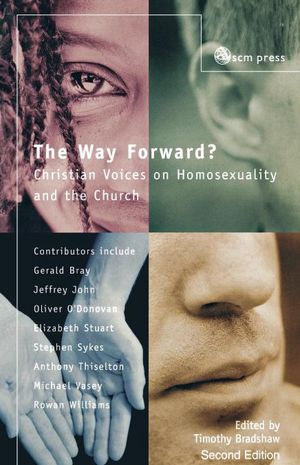
I've blogged extensively, earlier in the year, on the topic of the attempt to redefine marriage in the UK, I've stepped back from blogging about issues of sexuality, especially homosexuality. When asked, I refer people to my 'position post', in which I lean on John Stott's little booklet as well as my pastor John Wright's two superb talks. "Christianity and Homosexuality: a New Approach" contains links and references to many other sources and perspectives. As it is such a controversial and sensitive issue, it needs to be approached very carefully. So, today, I'm blogging a book review of a slim volume on the subject that I have found to be very helpful.
"The Way Forward? Christian Voices on Homosexuality and the Church", edited by Timothy Bradshaw, published by SCM Press, and now in its second edition, is an excellent multi-perspective volume from key voices within the Anglican Church on this topic. With contributions from Jeffrey John (the current Dean of St. Albans and at the centre of a C of E 'gay bishop' controversy), Rowan Williams (Current Archbishop of Canterbury), Anthony Thiselton (superb theologian) and psychiatrist Tom Brown, among others, this is a volume that demonstrates the depth and breadth of Anglican thinking on the subject.
The foreword by Stephen W. Sykes is immensely helpful, with its 2003 words relating to the fact that this is a political-ecclesial issue ringing very true at the moment. Setting the tone, in a debate like this, is very helpful. I will conduct my review with a general overview of some essays, and more specific engagement with a few of them.
Rowan Williams essay, which is the first in this volume, is intriguingly titled "Knowing Myself in Christ". Williams is on top form here; cerebral, engaged, pastoral and sensitive. Yet also very careful. His statement "The Church cannot publicly endorse any form of life other than singleness or monogamous heterosexual marriage as a legitimate expression of response to God's call" is a good starting point - though as ever, Rowan's position is more nuanced. This is immensely helpful, not least as at the time of writing he was embarking on 'Mission Impossible: Anglican Communion-Unity'. I am grateful that Rowan states that "as with other issues... the assumption is very readily made that an impassable gulf divides people called 'liberals' from people called 'traditionalists'. This Statement [He us talking about the St. Andrews Day Statement, reproduced in the book] is careful to avoid such glib sloganeering". Rowan's essay, his tone, and what he says are all marks of the man - and it is fitting that he opens this book, in which various Anglican perspectives from across the spectrum are given airtime.
Oliver O'Donovan - Regius Professor of Moral and Pastoral Theology at Oxford at time of writing - opens his essay with a title that is a key question; "Homosexuality in the Church: Can there be a fruitful theological debate?". This is a key question, and I am grateful that he is quick to state that "it is a debate 'about', not a debate 'with'". This is key, and is echoed in his concluding plea for patience in dialogue. Gerald Bray, Anglican Professor of Divinity at the time of writing, echoes some of what O'Donovan says. His closing words are a powerful challenge, yet almost encouraging, to evangelicals; "those who adovcate a liberalisation of the Church's teaching and practice... are far more likely to be wanting to make a political statement... regardless of what anybody else thinks about it. Evangelicals might as well be realistic... and learn to present their own case accordingly, without losing the note of compassion which this Statement is so concerned to sound". This is a good essay, with a compassionate evangelical heart.
Jeffrey John gives his essay, perhaps unsurprisingly, the title "Christian Same-Sex Partnerships". Reading John's essay is quite tricky, because he spends a lot of time talking about what he thinks the statement is saying, which is not necessarily the case, or necessarily clear at times! Jeffrey John is quick to define what he thinks is appropriate in terms of Christian Same Sex Partnerships - "a faithful, lifelong same-sex partnership (and let me be clear that I am defending no other kind of homosexual practice)", is useful, even insofar as it is frustrating. Jeffrey John spends the rest of his essay giving a spirited defence of his position, engaging with science, sin, Romans 1, before moving on to more practical matters. His position is fatally weakened by the fact that it is extended rhetoric - with no clear reference to sources - indeed, his bibliography has only three. For all the frustration of reading this essay, I am grateful for Jeffrey John's clearly articulate and compassionate heart in the debate. It is clear that he has a heart for individuals, the difference of course is what he might recommend pastorally.
I confess that the next few essays did not pique my interest as much as the first four. It was neither the titles nor the Author's that put me off - I merely found myself personally less interested in the topic. Michael Vasey, in "Travelling Together", offers a methodical analysis of the St. Andrews Statement, concluding that we need to do more work on giving gay people a framework, and to focus less on genital acts and more on society! Elizabeth Stuart's "Dancing in the Spirit" is a rather different piece, well worth reading, but a typically 'liberal' approach grounded as she is in queer theory. Her essay does make for interesting reading, though. John Colwell's "Christ, Creation and Human Sexuality" opens with a good awareness of the difficulty of speaking into debates that one does not personally identify with, he opens with "I am not a homosexual". His conclusion focuses on sexuality and leadership - and we can be grateful for what he writes here. His closing sentence is powerful; "The man or woman in Christian leadership will be especially concerned to live truthfully as well as lovingly, trustfully, hopefully and, perhaps above all, thankfully".
Dave Leal's chapter, "Questions of Clarification", is a useful one. Clarification and definition of terms in a debate is key, especially in such 'hot topic' as this (a point I made in an unrelated recent post). In the vein of Vasey's chapter, it is a methodical analysis. Leal makes a bold point in his conclusion; "Perhaps by understanding the special character and horizon of the marriage relationship more fully we might be enabled to distinguish sexual affection more clearly from other aspects of human affection than is common, and to understand what constitutes right order and what disorder in our affections". I humbly suggest Tim Keller's "The Meaning of Marriage" as a superbly accessible yet intelligently theological book on the topic of marriage. Simon Vibert wrote his PhD on the ultimate purpose of marriage, and this long view is reflected in his essay, "Divine Order and Sexual Conduct". Vibert takes us on an accomplished tour of the topic, reflecting on "God and Creation", before moving on to "Defining 'Personhood'", before affirming the statement. It is refreshing to have such an insightful defence of the Statement, closing with a bold exclamation of hope; "We still wait for the radical reordering of heaven and earth, and until that moment arrives we are called to live as people hoping for and anticipating the glory of that day". As an aside, Vibert's bibliography here is huge...
Martin Hallet, Director of the True Freedom Trust, writes an important essay; "Truth and Love in Our Sexual Feelings". His is a helpful essay, from the perspective of someone who grapples with same sex attraction, and seeks to live a life that puts God first in celibacy. He writes a fascinating section entitled "There is More to Sexuality than Sex", before asking the crucial question; "Are the Real Needs Sexual or Spiritual?". Hallet's essay is brave and clear, and we can be particularly grateful for the recognition at the opening of his conclusion; "I am so pleased that the St. Andrew's Day statement suggests that there is more to sexuality than a sexual act". But he closes with a clear warning about the need to remain faithful to the Bible's teaching. (For more on a TFT approach to the topic, you might like to read one of the most-read posts on my blog, "Guest Post: Changing Orientation", written for me by a wonderful older friend who is involved in True Freedom Trust).
The final two essays are also superb. Tom M. Brown's "A Psychiatrist's Perspective" is a welcome window into one of the key elements in this discussion. All to easy orthodox Christians can end up looking like fringe nutters - here we have one who is also a consultant psychiatrist engaging winsomely in the discussion. Brown has a key warning to those of us in the church; "My experience of those of homoseuxal orientation who are within the Church is that for the large part they feel that their needs for warmth, understanding, friendship and fellowship are simply not being met". This is a sobering challenge. Brown then reviews current research on the topic, which is useful in a volume of this relatively small size, concluding that "scientific evidence thus far simply undermines the complexity of understanding the origins of homosexual orientation". Brown closes with an appeal for the Gospel of Grace to define our relationships with everyone. Anthony C. Thiselton presents with a classic Thiselton title; "Can Hermeneutics Ease the Deadlock? Some Biblical Exegesis and Hermeneutical Models". This is by far the longest essay in the book - not least because Thiselton uses several pages for his 150+ notes and references. This is a serious essay, deeply academic and rigorous, which upholds the St. Andrews Day Statement and indeed orthodox opinion, with great panache and depth.
In conclusion, then, this is a very helpful book. It demonstrates the breadth and depth of sincere Christian thought on this contentious subject, and it is helpful to have some of the best articulations of various positions laid out for all to see. For anyone wanting to get a handle on what Anglican Church, in its breadth and variety, has actually said, this is a helpful volume. For all Christians, Anglican or otherwise, this is a valuable resource, drawing together psychiatry, hermeneutics, exegesis, opinion, liturgy and theology in a profoundly accessible and pastoral way.
_________________
UPDATE 29/11/13 - A great new website launched today, looking at this complex issue through the perspective of individuals, theological thought, and book reviews. Endorsed by some great folks and well designed, check out Living Out!
Perhaps a read of this article and associated book will give you a more effective handle on the issues involved.
ReplyDeletehttp://www.huffingtonpost.com/george-elerick/jesus-in-drag-straight-christians-comes-out-for-book_b_1569051.html
http://www.Indiegogo.com/timothykurek
hi anonymous. thanks for the comment, I will have a read.
ReplyDelete